


In Finnish/Suomeksi: https://kukkialle.fi/lasikuituvenehylky-kampanja/
The Bad Boats Recycling Project is one of the candidates in Agricultural and Rural Inspiration Awards 2026- competition.
Get more information and vote here
Euroopan parhaat maaseutuhankkeet palkitaan kansainvälisessä Agricultural & Rural Inspiration Awards (ARIA) -hankekilpailussa 2. joulukuuta. Lasikuituveneiden kierrätyshanke on yksi kilpailun finalisteista. Käy lukemassa lisää ja äänestämässä hanketta maaseutuverkoston sivujen kautta
Fiberglass wrecks more dangerous to aquatic life than previously thought
A recent study[1] indicates that fiberglass may be just as dangerous as asbestos. A total of 59 pieces of fiberglass debris were collected from the Kukkiajärvi area in September 2025. Nearly 100 volunteers reported the wrecks or helped collect them. The Kukkia Bad Boatd Recycling Project published a guide that makes it easy to organize similar recycling efforts.
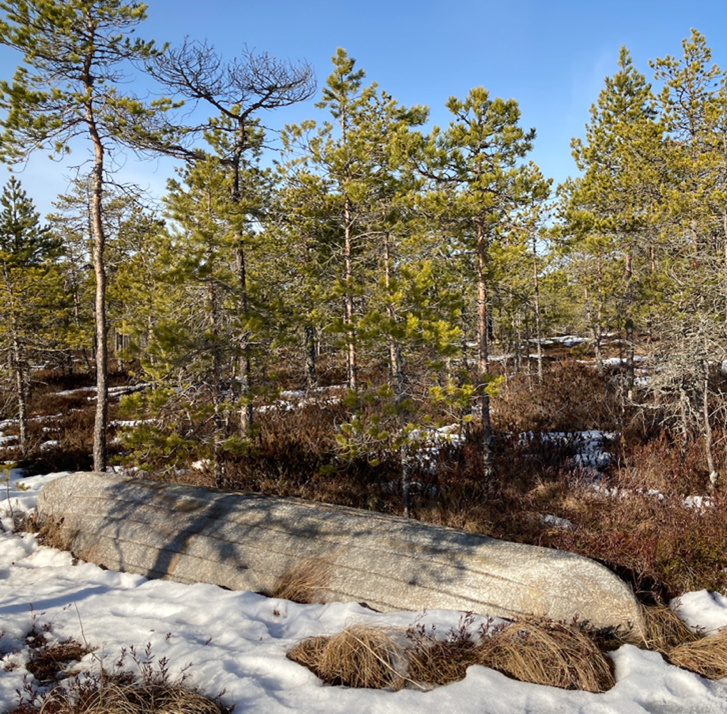
In the summer of 2025, the Kukkia Nature Center organized a field trip to the protected Kurkisuo. We found a boat wreck with its fiberglass already fully exposed on the shore of small Lake Kurkijärvi. A few of us leaned against the wreck while listening to the guide’s explanation, with the result that shards of fiberglass got caught in our clothes and sparkled in the sun. We were left wondering what impact these shards might have on the marsh’s unique natural environment.
[1] Ciocan, C., Annels, C., Fitzpatrick, M., Couceiro, F., Steyl, I., & Bray, S. (2024). Glass reinforced plastic (GRP) boats and the impact on coastal environment–Evidence of fibreglass ingestion by marine bivalves from natural populations. Journal of hazardous materials, 472, 134619.
Research Background: Fiberglass Is Like Asbestos
“My team is the first in the world to identify the effects of emissions from fiberglass boats on the aquatic life in coastal areas. Exposure to the elements weakens fiberglass boats. Over time, the resin softens, swells, cracks, and exposes the fiberglass, which then breaks down,” said Corina Ciocan in her presentation at the project’s final seminar, describing the work of the research group at the University of Brighton.
Ecotoxicologist Ciocan reported on research findings indicating that microfibers released from fiberglass boats have a dramatic effect on small zooplankton, which is the most important food source for invertebrates, fish fry, and even birds. For example, plastic resin particles adhered to the surface of water fleas, and after an hour and a half, all the test animals had sunk to the bottom of the test tank, dead, due to the extra weight.
A research team from the University of Brighton studied clams and oysters. In a catch harvested near boat docks in the winter, there were nearly 7,000 fiberglass particles per kilogram of oysters! In her presentation, Ciocan showed a photo of a tiny snail with 27 glass fiber strands sticking out of its shell! If contaminated plants and animals enter the food chain, it is clear that the glass fiber will move up the food chain and eventually, of course, reach humans. “I’m afraid that fiberglass is just as dangerous as asbestos,” Corina Ciocan said in her presentation.’
[1] Ciocan, C., Annels, C., Fitzpatrick, M., Couceiro, F., Steyl, I., & Bray, S. (2024). Glass reinforced plastic (GRP) boats and the impact on coastal environment–Evidence of fibreglass ingestion by marine bivalves from natural populations. Journal of hazardous materials, 472, 134619. Research Background: Fiberglass Is Like Asbestos
What did we do?
We asked people to report shipwrecks.
The Fiberglass Wreck Project partnered with the Finnish Environment Institute’s Rosgis information service, through which we obtained a dedicated reporting pages form for Lake Kukkiajärvi. We encouraged local residents on social media and in the local newspaper to report wrecks.
Photo: social media posts about perch
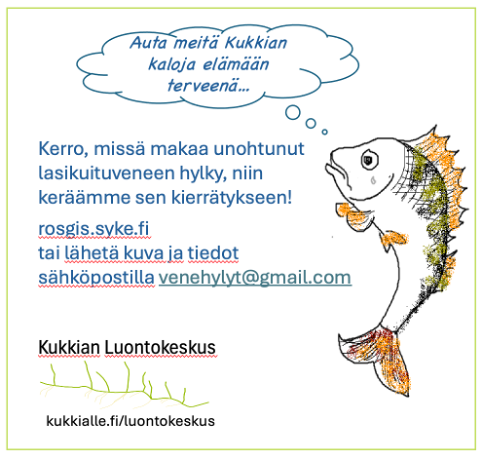
Results: We received a total of 79 wreck reports, mainly from the northern part of Lake Kukkiajärvi.
We went to inspect the boat wrecks and posted notices
A project staff member inspected each wreck and identified the landowner through the official records, as well as the boat’s owner. If the owner could not be found, we contacted the landowner and, after obtaining permission, posted a removal notice on the wreck.
Photo: A notice taped to the side of a wreck, asking the owner to remove the boat or to indicate that the boat must not be recycled.
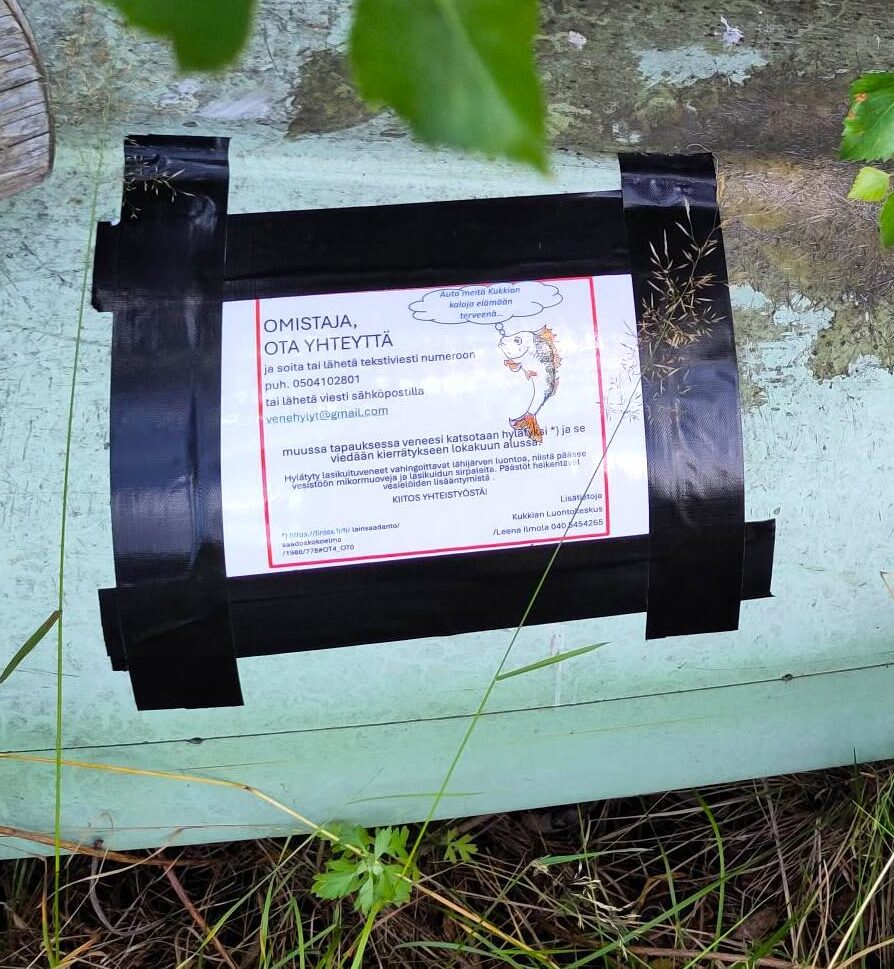
Results: Of the 79 reported wrecks, we found 70, as well as a few wrecks that had already sunk.
We organized a wreck collection event
We invited local residents to participate in the cleanup, which took place on September 15, 2025. We formed five cleanup teams, each consisting of 4–7 members and equipped with tools, a trailer, or a flatbed truck. Some of the reported boat wrecks had disappeared from the site or turned out to be in a location that was inaccessible.
Photo:the villagers gathered to help
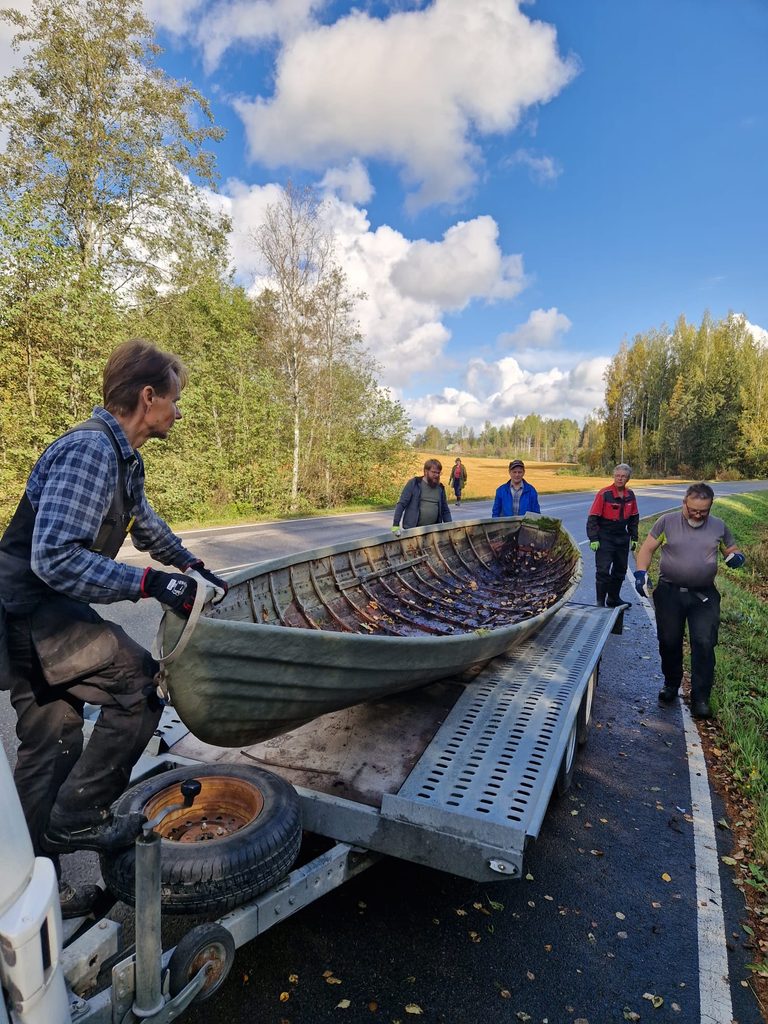
Result: We collected 59 wrecks
We sent the wrecks for recycling
During the wreck inspection, 5 boats were found to be repairable, so we could extend the lifespan of these boats. Local enthusiasts picked up the boats to have them restored. We negotiated an agreement with Kuusakoski Oy that allowed us to send all the collected wrecks for recycling as raw material for the cement industry.
Photo: Boat wrecks in temporary storage
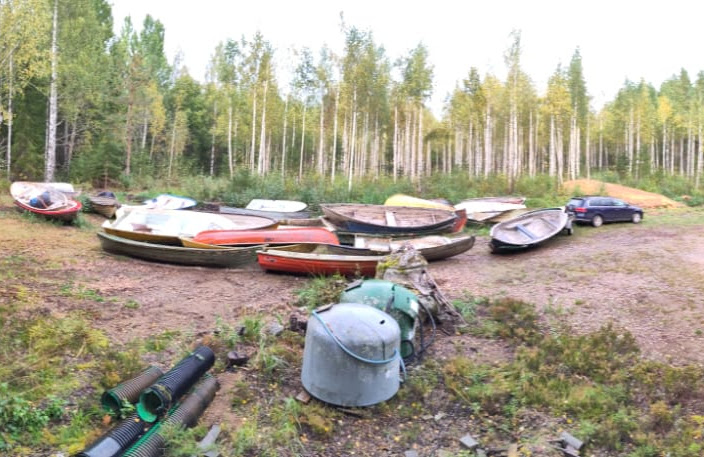
Results: In total, Kuusakoski removed 54 wrecks from the site.
Raising Awareness of Glass Fiber Emissions
We organized two seminars to raise awareness of the issue. At the project’s kickoff seminar, participants discussed the number of decommissioned glass fiber boats and the problems they pose for waste management. Speakers included representatives from the Ministry of the Environment, the Finnish Environment Institute, Pirkanmaan Jätehuolto Oy, and Kuusakoski Oy. At the results seminar, the main focus was on the research findings and a presentation of the work process. The Ministry of the Environment, Traficom, and Finnboat, the boat manufacturers’ organization, commented on the results. The media were invited to cover the seminars and visit the event locations.
Results: Yle produced two news stories on the topics for YLE News; Helsingin Sanomat published a one-page article in its science section; Maaseudun Tulevaisuus published two articles; Aamulehti published one; and the local Sydän-Hämeen Lehti published a total of five articles.
We compiled what we learned into a guide, which is available online
Based on the lessons learned from the project, the Kukkia Bad Boat Recycling Project has created a guide for volunteer groups explaining how to plan, fund, and organize such a project. In addition, the guide provides detailed instructions on how to carry out the collection and outlines the legal requirements. The guide can be found both on the project’s website: https://kukkialle.fi/lasikuituveneiden-kierratyskampanja/ and at the Kukkia Nature Center document portal https://kukkialle.fi/wp-content/uploads/2025/10/Verkko-opas-20251028.pdf
How we funded the project?
Kuusakoski Oy provided us with 50 euros per wreck as a recycling subsidy. We applied for funding from the local Leader group, Pirkan Helmi, to collect and recycle 30 wrecks. Kuusakoski agreed to accept all 54 wrecks. With Pirkan Helmi’s support, we were also able to hire a project staff member who verified the reports submitted, identified the landowners and boat owners, and organized a volunteer cleanup day.
What should we do if there are millions of boat wrecks in Finland’s lakes?
When we report the results of the Kukkiajärvi campaign for the month—79 wrecks multiplied by the number of lakes in Finland—the theoretical estimate will end up to be 4.74 million abandoned fiberglass boats.
What should we do, knowing that the current recycling system isn’t working? Municipalities have not actively collected old fiberglass boats from lake shores; waste management companies’ incinerators are unable to burn fiberglass boats on a large scale; and boat owners do not take their wrecks to waste collection stations. The boats have been “forgotten” on the shore. A large portion of the wrecks collected from Kukkia have been lying in place for several decades; their owners have either passed away or moved away from the area. Therefore, the recycling of these wrecks cannot be relied upon solely through guidance to the owners. Based on the discussions we’ve had, we’ve come to the conclusion that it will take years for the authorities to strengthen oversight of the current method and build a more comprehensive recycling system.
The most cost-effective and fastest way to remove even some of the wrecks from the natural environment is to do so through volunteer efforts. A prerequisite for removing the wrecks is that local residents keep their eyes open and report wrecks’ locations. Some of the wrecks are in such difficult-to-reach locations that collecting them requires a volunteer group familiar with the local waters. Furthermore, recycling costs money, so volunteers must secure funding to protect the lake ecosystem in this regard as well. Fortunately, funding is currently available—if one knows how to apply for it.
If we want to address this problem quickly, the villages around the lakes, water conservationists, and summer cottage owners must be mobilized to recycle the debris for which the owners take no responsibility.
For more information:
Kukkian Kasvattamo Cooperative, Leena Ilmola, tel. +358 40 5454265
Kukkian Kasvattamo is a nonprofit cooperative founded by active residents and organizations in Luopioinen, which aims to safeguard the vitality of the region’s people, communities, and nature through various projects.
The Kukkia Nature Center is an information network created through a collaboration between the non-profit Rautajärvi Region Villages, Inc., the Kukkia Conservation Association, Aito-Suvi ry, the Kukkia Kasvattamo Cooperative, and the Municipality of Pälkäne, which works to safeguard the region’s biodiversity through its activities. For more information, visit kukkialle.fi/luontokeskus.
Lake Kukkiajärvi is a Natura 2000 site due to its clear waters, rugged landscape, and rare aquatic plants, such as the water milfoil. The lake is also listed as a BirdLife IBA (Important Bird Area).

